The Cost of Running an AC by State in India (2026)
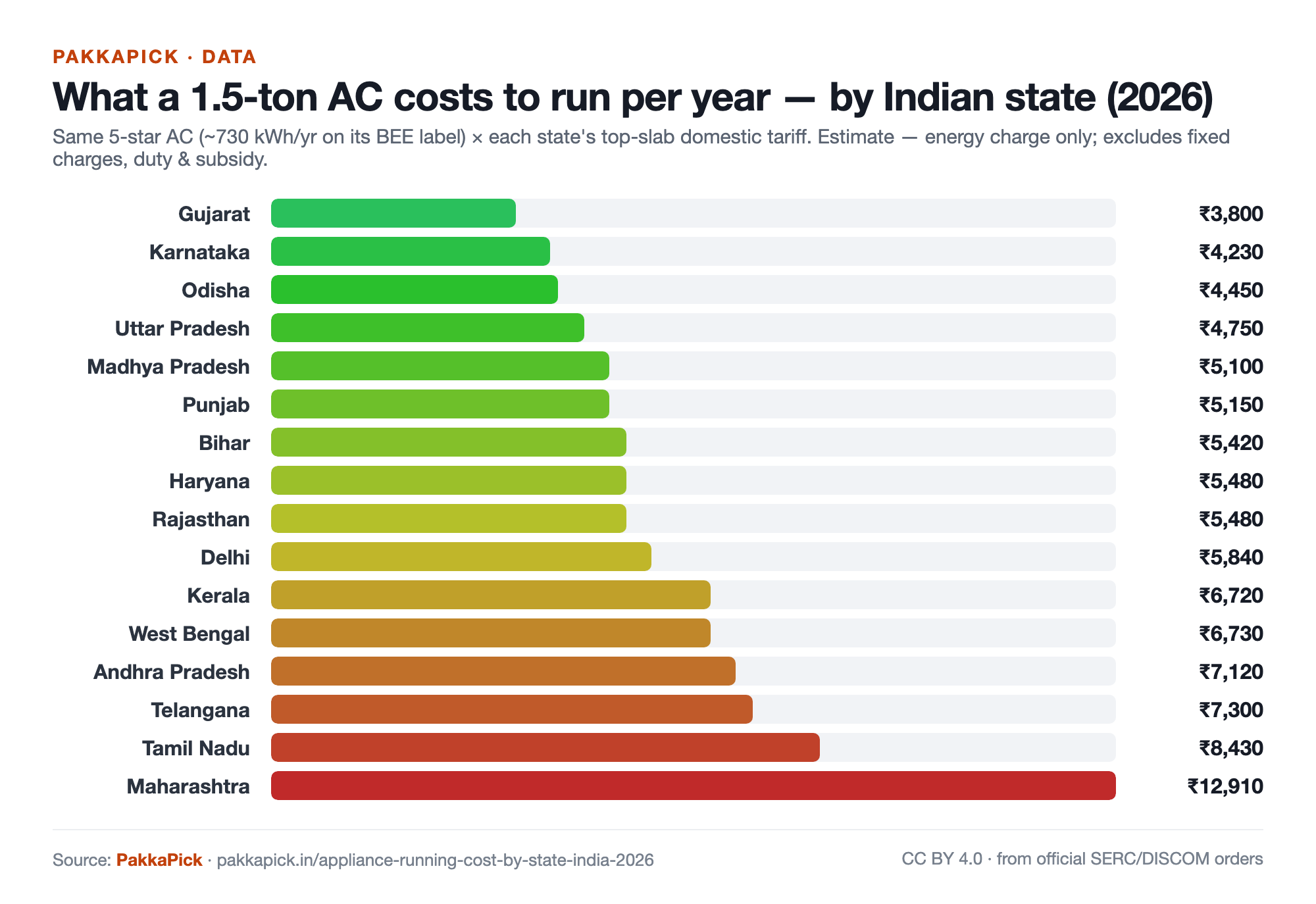
Buy the exact same air conditioner, and what it costs to run depends enormously on which state you plug it in. Because domestic electricity tariffs are set state-by-state, a 1.5-ton 5-star AC that costs about ₹3,800 a year to run in Gujarat costs about ₹12,910 in Maharashtra — roughly 3.4× more for identical hardware. We built the table below from official state tariff orders, not aggregators.
As of July 2026, Gujarat has the cheapest domestic electricity of the 16 major Indian states here at about ₹5.20 per unit, and Maharashtra the most expensive at ₹17.68 per unit — a 3.4× gap. At each state's top slab, the same 1.5-ton 5-star AC (~730 units/year) costs about ₹3,800/year (≈₹320/month) in Gujarat versus about ₹12,910/year (≈₹1080/month) in Maharashtra. One unit = one kilowatt-hour (kWh); figures are the energy charge for a household heavy enough to reach its top slab.
Cheapest five per unit: Gujarat (₹5.20), Karnataka (₹5.80), Odisha (₹6.10), Uttar Pradesh (₹6.50), Madhya Pradesh (₹6.98). Most expensive: Maharashtra (₹17.68), Tamil Nadu (₹11.55), Telangana (₹10.00), Andhra Pradesh (₹9.75), West Bengal (₹9.22). The median top-slab domestic rate across these 16 states is about ₹7.50/unit.
Use this data
All 16 states as a CSV — top-slab rate, annual AC & fridge cost, the issuing regulator and a verification status per row. Free to reuse with attribution (CC BY 4.0).
How to cite: PakkaPick, “Appliance Running Cost by State (India 2026),” pakkapick.in/appliance-running-cost-by-state-india-2026 — CC BY 4.0
Embed this chart on your site
Free to use with a link back (CC BY 4.0). Copy the code — it drops in the chart below with attribution.
<a href="https://pakkapick.in/appliance-running-cost-by-state-india-2026"><img src="https://pakkapick.in/charts/ac-running-cost-by-state-2026.png" alt="What a 1.5-ton AC costs to run per year by Indian state (2026) — PakkaPick" style="max-width:100%;height:auto" /></a>
<p>Source: <a href="https://pakkapick.in/appliance-running-cost-by-state-india-2026">PakkaPick — AC running cost by state in India (CC BY 4.0)</a></p>
Electricity Cost to Run an AC & Fridge, by State
Each row is the top domestic slab energy charge from that state's official FY2025-26 tariff order, applied to a 1.5-ton 5-star AC (~730 units/year) and an average refrigerator (~461 units/year). Rates are the energy charge only. States are sorted cheapest to most expensive.
| State | Top slab rate (₹/unit) | AC ₹/year | Fridge ₹/year | Applies to |
|---|---|---|---|---|
| Gujarat | ₹5.20 | ₹3,800 | ₹2,400 | above 250 units/mo |
| Karnataka | ₹5.80 | ₹4,230 | ₹2,670 | flat — all units |
| Odisha | ₹6.10 | ₹4,450 | ₹2,810 | above 400 units/mo |
| Uttar Pradesh | ₹6.50 | ₹4,750 | ₹3,000 | above 300 units/mo |
| Madhya Pradesh | ₹6.98 | ₹5,100 | ₹3,220 | above 300 units/mo |
| Punjab (rate corroborated across sources, not directly verified from the primary tariff order) | ₹7.05 | ₹5,150 | ₹3,250 | above 300 units/mo |
| Bihar | ₹7.42 | ₹5,420 | ₹3,420 | flat — DS-II urban |
| Haryana | ₹7.50 | ₹5,480 | ₹3,460 | above 1000 units/mo |
| Rajasthan | ₹7.50 | ₹5,480 | ₹3,460 | above 500 units/mo |
| Delhi (rate corroborated across sources, not directly verified from the primary tariff order) | ₹8.00 | ₹5,840 | ₹3,690 | above 1200 units/mo |
| Kerala | ₹9.20 | ₹6,720 | ₹4,240 | above 500 units/mo |
| West Bengal | ₹9.22 | ₹6,730 | ₹4,250 | above 900 units/mo |
| Andhra Pradesh | ₹9.75 | ₹7,120 | ₹4,490 | above 400 units/mo |
| Telangana | ₹10.00 | ₹7,300 | ₹4,610 | above 800 units/mo |
| Tamil Nadu (rate corroborated across sources, not directly verified from the primary tariff order) | ₹11.55 | ₹8,430 | ₹5,320 | above 500 units/mo |
| Maharashtra | ₹17.68 | ₹12,910 | ₹8,150 | above 500 units/mo |
* Rate corroborated across multiple sources; the official PDF was unreachable from our servers, so treat as indicative pending a direct read. All other rows were parsed directly from the primary tariff order. AC = 1.5-ton 5-star split at its ~730-unit BEE label; fridge = 461-unit measured Indian average (Prayas). Energy charge only — see methodology below.
Estimate Your Own Running Cost
Pick your state and appliance to estimate the yearly electricity cost, using the same top-slab tariffs and BEE energy figures as the table above.
Air conditioner (1.5-ton, 5-star) in Maharashtra costs about
₹12,910 / year
roughly ₹1,080/month — about 730 units/year × ₹17.68/unit (top slab)
Estimate only — energy charge on the top domestic slab, before fixed charges, duty and any state subsidy. Basis: 1.5-ton 5-star split at its ~730-unit BEE label (~1,600 hrs/yr). Your bill depends on your slab, exact usage and local charges.
Three States That Don't Play by the Usual Rules
Karnataka: no slabs
Karnataka scrapped telescopic slabs in 2025. Every unit — your first and your ten-thousandth — is billed at one flat ₹5.80. Simple, and among the cheapest.
Kerala: a cliff at 250 units
Cross 250 units in a month and your entire bill — not just the extra units — jumps to a single flat rate, up to ₹9.20/unit. An AC that tips you over the edge re-prices everything.
Tamil Nadu: billed bi-monthly
TN bills every two months and has the steepest top slab here at ₹11.55/unit — but only on units above 1,000 per two-month cycle, and the first 100 units are free.
How we read this — and why the numbers are honest
- Top-slab (marginal) rate. Tariffs are slab-based; an AC or geyser pushes a home into its highest slab, so the units it adds are billed at (or near) that top rate. That marginal rate is what running an appliance actually costs. Lighter users on lower slabs pay less.
- Top slabs start at different levels. The consumption needed to reach the top rate varies a lot — above 300 units/month in Madhya Pradesh and Uttar Pradesh, but above 900 in West Bengal and above 1,200 in Delhi (see the "Applies to" column). A home below its state's threshold pays a lower middle-slab rate, so read the AC and fridge figures as the cost for a household heavy enough to sit in its top band.
- Energy charge only. These are per-unit energy charges. Real bills add fixed/demand charges, fuel adjustment (FAC/FPPCA/PPAC) and electricity duty — roughly 10–30% more (highest in Maharashtra and Delhi) — and some states subtract a subsidy. We compare the energy charge because it is the state-set part that scales with usage.
- Appliance units from BEE. The AC figure (~730 units/year) is the BEE label value for a 1.5-ton 5-star at 1,600 running hours; the fridge (~461 units/year) is a measured field average. Your real use varies with hours, weather and settings.
- Primary sources. 13 of 16 rates were parsed directly from the official tariff order PDF; the 3 marked * are corroborated across sources where the official file was unreachable. Every row links to its regulator or DISCOM tariff order below.
What This Means When You Buy an AC
The steeper your state's tariff, the faster an efficient appliance pays for itself. Stepping from a 3-star to a 5-star 1.5-ton AC saves roughly 200–290 units a year. That saving is worth about ₹1300 a year in Gujarat but about ₹4420 a year in Maharashtra — so in a high-tariff state the 5-star premium pays back about 3.4× as fast.
For the full picture on appliance efficiency — AC, fridge, fan, geyser and washing machine units and costs — see our companion guide, the real cost of running home appliances in India.
Frequently Asked Questions
Which Indian state has the cheapest electricity for running an AC?
Which state is the most expensive to run an AC in?
Which state has the cheapest electricity in India in 2026?
How much does it cost to run an AC per month in India?
Why do you use the "top slab" rate and not an average?
Are these the full electricity rates I pay?
Why is Kerala’s structure different?
How current is this data?
Sources & Methodology
Annual running cost = appliance annual units (kWh) × the state's top-slab domestic energy charge. Tariffs are the highest domestic slab from each state's FY2025-26 (or in-force FY2026-27) tariff order; appliance units are from BEE labels and Prayas (Energy Group) field data. Every rate below links to its official regulator or DISCOM tariff order:
- Gujarat — GERC: ₹5.20/unit, above 250 units/mo. GERC held FY2026 tariffs at prior-year levels. Prepaid meter is ₹5.10.
- Karnataka — KERC: ₹5.80/unit, flat — all units. KERC 2025 order abolished domestic slabs — one flat 580 paise rate for every unit.
- Odisha — OERC: ₹6.10/unit, above 400 units/mo. Slabs ₹2.90 / ₹4.70 / ₹5.70 / ₹6.10. Held unchanged for FY2025-26.
- Uttar Pradesh — UPERC: ₹6.50/unit, above 300 units/mo. Consumer-payable urban LMV-1 rate; no separate >500-unit band.
- Madhya Pradesh — MPERC: ₹6.98/unit, above 300 units/mo. MPERC FY2025-26 LV-1.2: ₹4.45 / ₹5.41 / ₹6.79 / ₹6.98.
- Punjab — PSERC: ₹7.05/unit, above 300 units/mo. FY2026-27 rate, cut from ₹7.75. Two-slab domestic structure.
- Bihar — BERC: ₹7.42/unit, flat — DS-II urban. FY2026-27 DS-II urban is a flat ₹7.42/unit. A large state subsidy is applied on top of this.
- Haryana — HERC: ₹7.50/unit, above 1000 units/mo. Category III (load >5kW): ₹6.50 / ₹7.15 / ₹7.50. A ≤5kW home tops out near ₹7.10.
- Rajasthan — RERC: ₹7.50/unit, above 500 units/mo. JdVVNL/RERC 2025 order: 750 paise above 500 units, plus a ₹1/unit regulatory surcharge.
- Delhi — DERC: ₹8.00/unit, above 1200 units/mo. 5-slab: ₹3.00 / ₹4.50 / ₹6.50 / ₹7.00 / ₹8.00. Govt subsidy (first 200 units free) and PPAC are excluded.
- Kerala — KSERC: ₹9.20/unit, above 500 units/mo. Above 250 units the WHOLE bill is charged at one flat rate — a cliff, not a top slab. >500 units = ₹9.20 on every unit.
- West Bengal — WBERC: ₹9.22/unit, above 900 units/mo. WBSEDCL Domestic (Urban) 6-band table: ₹5.04 / ₹6.33 / ₹7.12 / ₹7.52 / ₹7.69 / ₹9.22 (above 900 units). WBSEDCL only — CESC Kolkata is separate.
- Andhra Pradesh — APERC: ₹9.75/unit, above 400 units/mo. APERC FY2025-26 (Cat I-A Domestic Telescopic): 226-400 ₹8.75, above 400 ₹9.75, plus a ₹10/kW fixed charge.
- Telangana — TSERC: ₹10.00/unit, above 800 units/mo. LT-I(B)(ii): ₹5.10 / ₹7.70 / ₹9.00 / ₹9.50 / ₹10.00.
- Tamil Nadu — TNERC: ₹11.55/unit, above 500 units/mo. Bi-monthly telescopic (Order 6 of 2025); ₹11.55 is the top marginal slab.
- Maharashtra — MERC: ₹17.68/unit, above 500 units/mo. MERC Order 75 of 2025 (eff 1 Jul 2025): ₹4.28 / ₹11.10 / ₹15.38 / ₹17.68 energy charge, plus ₹1.47 wheeling (₹19.15 total variable) and 16% duty — India's highest domestic tariff by a wide margin.
Figures are energy charges only and exclude fixed charges, fuel/power-purchase adjustment, electricity duty and subsidies, which vary by state and month — verify your exact rate on your latest bill. Tariffs change with each regulatory order; we update this page as new orders are issued. This page contains no product prices and no price-history data.
Shopping for an Efficient Appliance?
In a high-tariff state, a higher BEE star rating pays back faster. Our buying guides pick the models worth it: